Unilever and Samsung Collaboration: How Smart Packaging Leads the Laundry Market
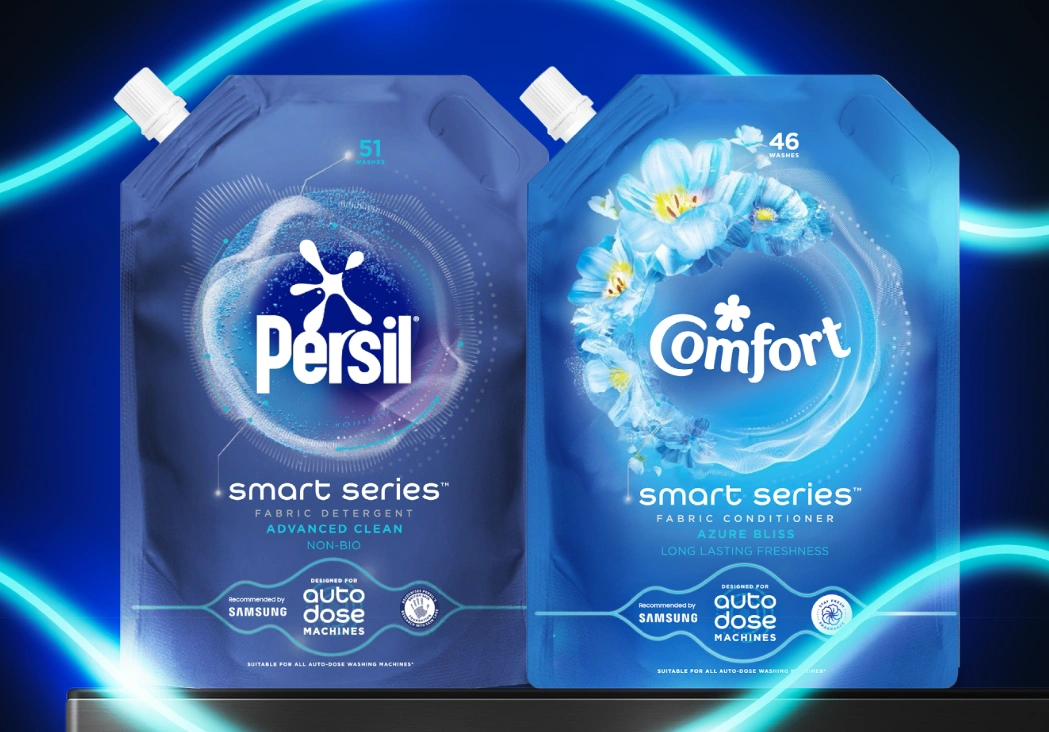
In today's fast-evolving consumer market, the integration of smart home technology and daily chores is creating an unprecedented industrial change. This partnership between home appliance and consumer goods giants not only changes lifestyles but also brings new challenges and opportunities to the packaging industry. Unilever’s recently launched Persil and Comfort "Smart" series are products of this trend. Developed specifically for Samsung’s auto-dosing washing machines, they aim to redefine the traditional chore of laundry through technology.
As global urbanization accelerates and the "lazy economy" grows, smart appliances are entering many homes. Samsung’s auto-dosing technology uses built-in sensors to identify laundry weight, fabric type, and soil levels to automatically dispense the exact amount of liquid. These technical advances require detergents to evolve; the mission of the Smart series is to serve as a high-efficiency "component" within the smart laundry system. This shifts the consumer habit from "pouring for every wash" to "refilling once a month," breaking the traditional consumption path.
During development, Unilever tested a Direct-to-Consumer (DTC) sales model. With the rise of online retail and subscription services, packaging design has shifted its focus from "shelf appeal" to "logistics efficiency." As a DTC product, being lightweight is the top priority. To reduce shipping costs and carbon footprints, Unilever chose flexible plastic pouches instead of traditional hard plastic bottles for the Smart series to achieve extreme weight reduction.
However, recycling flexible plastic remains a global challenge. While it creates lower carbon emissions during production and transport, its complex material makes recycling expensive and technically difficult. Consequently, Unilever recently extended its deadline to achieve 100% recyclable, reusable, or compostable flexible packaging by ten years. This decision reflects the difficult balance between idealistic sustainability goals and realistic technical bottlenecks.
In early research, Unilever tried using traditional bottles, but found that consumers had misconceptions about volume when using auto-dosing machines. Many users would only fill the tank halfway or question why such a large bottle was needed for a one-time refill. The flexible pouch sends a clear signal: this is a "consumable" for refilling. While not the perfect final form, it is currently the best balance between logistics, cost, and user habits. The team is now exploring more sustainable options, such as easy-to-recycle thin-walled PET bottles and paper-based pouches.
In terms of industrial design, Unilever addressed user pain points. For auto-dosing machine users, pouring detergent into narrow tanks without spilling is a common problem. To prevent waste and machine corrosion caused by spills, the Smart series pouches feature a specially designed plastic nozzle. This device replaces the traditional measuring cup, allowing for precise pouring that stops immediately when tipped back, greatly improving the user experience. Samsung’s research shows that auto-dosing systems can reduce detergent waste by up to 15%, a key step toward sustainable consumption.
For brand communication, Unilever worked with the design agency Design Bridge to introduce a high-tech "sphere" pattern on the packaging. This sphere represents the core marketing concept of "Detergent Optimization & Smart Estimation" (D.O.S.E.). By using AI-generated visuals, the brand conveys a "future tech" feel to make laundry more appealing. This strategy has performed well on social media, positioning Persil and Comfort as tech-forward pioneers. This deep link between packaging and digital marketing helps consumers understand the technology behind the product, boosting brand loyalty.
The release of the Smart series marks a new era for home care driven by smart hardware. Packaging is no longer just a container; it is the link between smart appliances, logistics networks, and users. Despite challenges like recycling, cross-industry collaboration and material innovation are creating a more efficient and eco-friendly laundry ecosystem. For packaging and printing companies, this signals that future competition will be a test of material science, logistics efficiency, and smart interaction.



Contact Us




Copyright © 2023 apppexpo.com 保留所有权利 沪ICP备12019481号-1 |  沪公网安备31010102008440号