Tsinghua University Breaks World Record for 3D Printing Speed
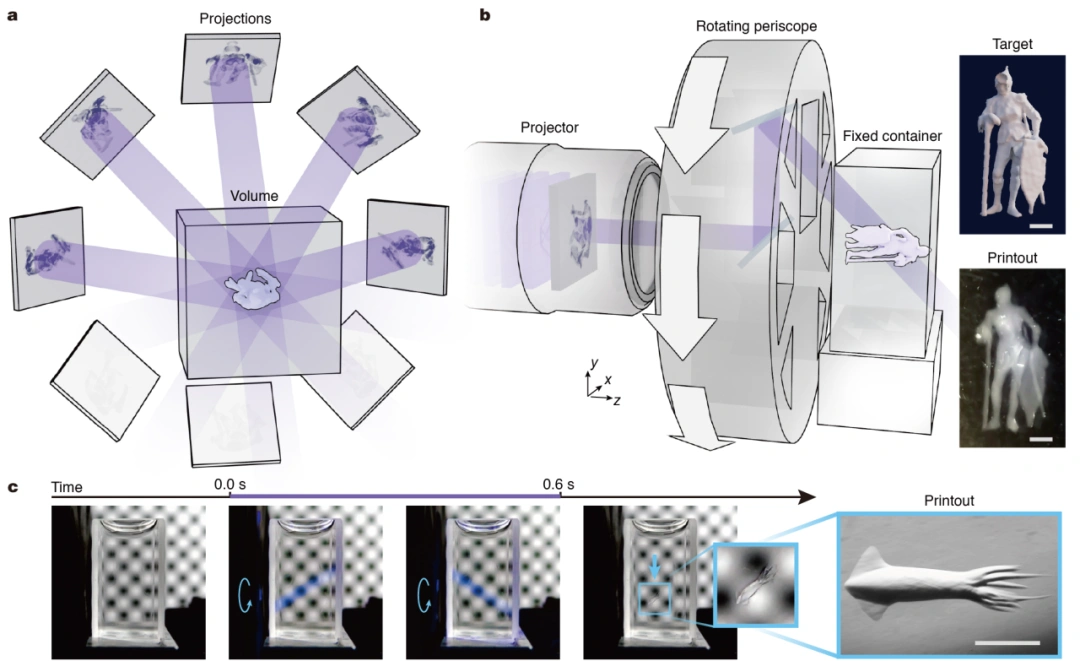
After five years of research, the Imaging and Intelligent Technology Laboratory at Tsinghua University has developed "Computational Holographic Light-Field 3D Printing" technology. This breakthrough completed the high-resolution 3D printing of a millimeter-sized complex object in just 0.6 seconds, setting a new world record. Team leader Dai Qionghai, an academician of the Chinese Academy of Engineering, noted that the technology's applications could expand to fields like micro-robotics.
Traditional 3D printing usually works point-by-point or layer-by-layer, often taking tens of minutes or even hours to finish millimeter-scale objects. While some scientists previously proposed volumetric printing techniques to improve speed, their use was largely limited by the shape of the containers.
Dai Qionghai explained that the new technology innovates the optical system design. By using a high-speed rotating periscope, it creates a high-resolution 3D light-field distribution to build objects without needing to rotate the sample itself. Experiments show that this method processes complex millimeter-sized structures in only 0.6 seconds, with a precision as fine as 12 micrometers. It can accurately project complex 3D light intensity in a very short time to achieve rapid printing.
This new technology has a wide range of applications. For example, it can use biocompatible materials to print spiral or branched tubes that mimic blood vessels. It also allows for "in-situ printing" directly on petri dishes or biological tissues, opening new possibilities for tissue engineering and high-throughput drug screening. Additionally, it could enable the mass production of micro-components like photonic computing devices and mobile camera modules, as well as parts with sharp angles and complex surfaces. Future applications may also extend to flexible electronics and micro-robots.
soure:Internet



Contact Us





Copyright © 2023 apppexpo.com 保留所有权利 沪ICP备12019481号-1 |  沪公网安备31010102008440号